High-Rise Leggings Roll Down for One Reason, and It Isn't the Waistband
Quick Answer: High-rise leggings roll when the top edge of the band sits above your natural waist, on the part of your torso that widens toward the ribcage — the band is then being pushed outward from below, and the top edge folds over because it’s the path of least resistance. A band that ends at or just below the narrowest point of your waist has nothing pushing it outward and stays flat.
More compression doesn’t fix this. It usually makes the fold sharper.

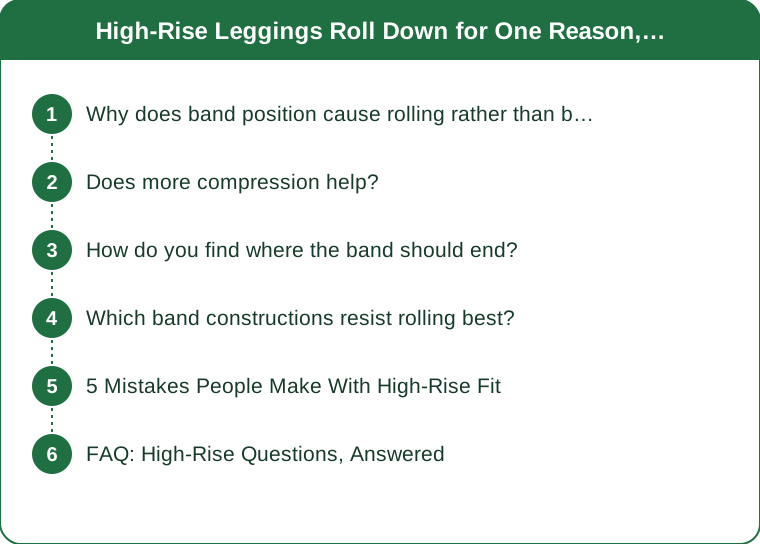
Why does band position cause rolling rather than band quality?
Rolling is a folding failure, and folding requires an outward force at the top edge. When the band’s top edge sits at your narrowest point, the torso above it flares gradually outward but the band isn’t spanning that flare — so there’s no force trying to push the edge over.
Push the same band an inch or two higher and its top edge is now spanning a section of torso that’s actively widening. The fabric is stretched hardest at that top edge, and the widening ribcage pushes outward against it. The edge folds over because folding is how the fabric relieves that tension. This is why rolling almost always starts at the top edge and works downward.
Does more compression help?
It usually makes it worse, which is the counterintuitive part. A higher-compression band under the same outward pressure has more stored tension to release, so when it folds it folds harder and more decisively — often creating a tight rolled cord rather than a soft fold.
High compression also concentrates the pressure at the top edge specifically, which is exactly where the outward push is strongest. A moderately compressive band that ends at the right height outperforms a very tight band that ends too high, every time. Compression is a useful property, but it’s not a substitute for correct placement.
How do you find where the band should end?
Find your natural waist by bending sideways — the crease that forms is your narrowest point. The band’s top edge should sit at that crease or up to an inch below it.
Then check the rise measurement against your own: measure from crotch to that crease. If a pair’s stated rise exceeds your measurement by more than an inch, expect rolling regardless of the brand’s reputation. Many people who assume they need ‘extra high rise’ actually need standard high-rise, and are experiencing rolling caused by buying up rather than by inadequate hold.

Which band constructions resist rolling best?
Three features do the most work. A wide band — three inches or more — distributes the outward force across more surface, so no single line takes enough pressure to fold.
A band with a bonded or reinforced top edge resists folding structurally, since the edge is stiffer than the fabric below it. And silicone grip strips on the inside of the top edge anchor the band against skin so it can’t slide into a fold. Worth noting: a drawstring does nothing for rolling — it controls circumference, not the vertical forces that cause folding. Plenty of people buy drawstring pairs for this and find no improvement.
5 Mistakes People Make With High-Rise Fit
1. Buying the highest rise available by default. Higher isn’t better; it’s better only up to your natural waist.
2. Sizing down to stop rolling. A tighter band at the wrong height rolls harder, not less.
3. Blaming worn-out elastic. Elastic does degrade, but a pair that rolled from the first wear was always the wrong rise.
4. Expecting a drawstring to help. It manages circumference, not the outward push that causes folding.
5. Testing only while standing. Sit down and hinge forward before deciding — that’s when a marginally-too-high band reveals itself.
FAQ: High-Rise Questions, Answered
Do folded-over waistbands count as rolling?
Different thing — intentionally folding a band down is a styling choice that some designs accommodate. Unintentional rolling is the fabric relieving tension.
Does rolling get worse after eating or during the day?
Yes, because torso circumference changes slightly through the day, and a band already near its limit crosses the threshold. A band at the correct height has margin for this.
Are seamless high-rise bands more or less prone to rolling?
Slightly more, since seamless bands often lack the reinforced top edge that bonded bands have. Placement still matters more than construction here.
TL;DR:
- Rolling happens when the band’s top edge sits above your natural waist, where the torso widens
- More compression makes the fold sharper rather than preventing it
- Find your natural waist by bending sideways; the band should end at that crease or just below
- Wide bands, bonded top edges, and grip strips help — drawstrings don’t
High-rise is a measurement, not a maximum. Match it to your waist and the rolling stops.
See It in Motion
Seen here: High Waist Yoga Leggings with Side Pockets — shop it on bubblelime.com
Keep Reading
This article is for general informational and styling purposes only. Fit, sizing, and product availability may vary.