High-Rise Leggings at a Desk: Why They Feel Different After Two Hours
Quick Answer: Sitting compresses the distance between your ribs and hips by one to two inches, which pushes the waistband up into your lower ribcage. That is why the same pair feels fine at 9 a.m. and tight at 2 p.m. Pick for sitting by choosing a wider, softer band that spreads pressure instead of concentrating it, a rise you can sit in for a full minute without adjusting, and fabric with genuine recovery so the band does not slowly compress harder as it stretches out. Standing fit is not the test — seated fit is.

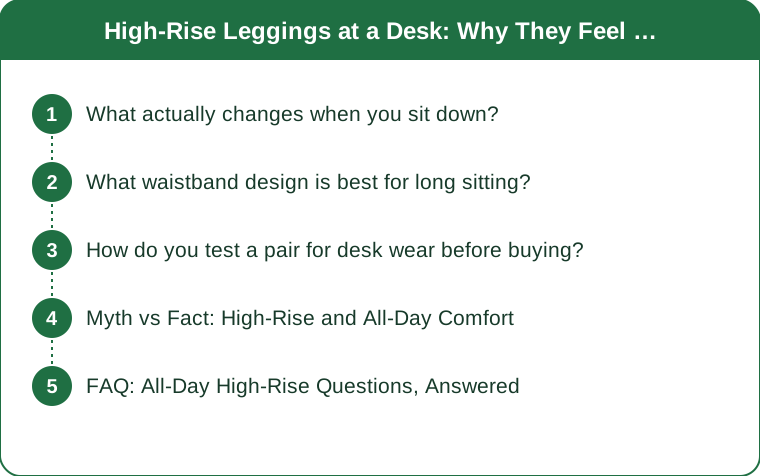
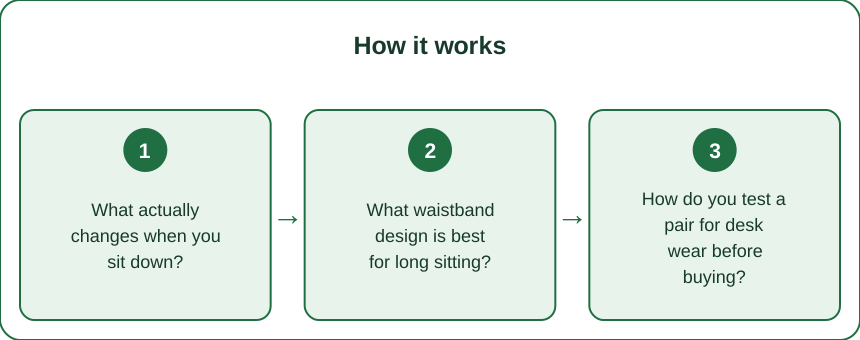
What actually changes when you sit down?
Your torso shortens in front. Standing, your ribcage and hip bones are at their maximum separation. Sitting, especially with any forward lean, the front of your torso folds and that distance closes by an inch or two.
The waistband does not move down with it. It is anchored on your hips, so the reduced distance means the top edge of the band travels upward relative to your ribs. A band that sat comfortably an inch below the ribcage now touches it.
At the same time, sitting redistributes soft tissue forward, so there is more volume for the band to contain in exactly the spot where it just moved.
Then there is breathing. Seated posture already reduces diaphragm movement slightly; a band pressing on the lower ribs adds to that. Most people register it as a vague discomfort rather than identifying it as breathing restriction, which is why it is easy to misdiagnose as the pair being the wrong size.
After eating, all of the above intensifies. This is not about size fluctuation — it is the same body in a different geometry.
What waistband design is best for long sitting?
Width, not tightness. A wide band — three inches or more — spreads the same holding force over more surface area, so the pressure per square inch drops. A narrow band applies all its force in a thin line, and that line is what digs in.
Soft or brushed inner face. The band is in continuous contact for hours. A slightly softer inner surface makes a disproportionate difference to how it registers over that time.
No internal drawcord or hard elastic edge. A drawcord knot sits right where you fold forward. A hard elastic band edge creates a pressure ridge.
Seamless or bonded top edge. A stitched-and-turned edge has a ridge; a bonded one does not.
Crossover or V-front styles are worth trying, since they lower the center front — exactly where seated pressure concentrates — while keeping side support.
Genuine recovery. This is the one people miss. A band that stretches out over the day does not get more comfortable; it slides down, gets pulled back up, and then the whole cycle repeats. Fabric that returns to shape stays put, and staying put is what comfort actually depends on.
What does not help: sizing up. A too-large band slides down, rolls at the top edge, and needs constant readjustment.

How do you test a pair for desk wear before buying?
The fitting-room routine that predicts an eight-hour day:
Sit for a full minute. Not a quick perch — actually sit, hands in your lap, and count. Most pressure problems announce themselves within 60 seconds, and almost none announce themselves standing.
Lean forward as if reading a screen. This is the position that closes the rib-to-hip distance the most.
Take a deep breath while seated. If you feel the band resist your ribcage expanding, that pair is not a desk pair no matter how it looks.
Stand back up and check whether you want to adjust. If your hands automatically go to the waistband, that instinct will happen a hundred times a day.
Do a full squat and check the band’s top edge for rolling. Rolling is a strong signal that the band is under too much tension at the top and will fold over when you sit.
And a note on time of day: try them on in the afternoon, not first thing in the morning. Most people’s midsection measurement changes slightly through the day, and afternoon is the harder test — which is exactly when you want to know.
Myth vs Fact: High-Rise and All-Day Comfort
Myth: High-rise is inherently uncomfortable for sitting. Fact: A well-designed high rise is often more comfortable seated than a mid-rise, because the band sits above the fold instead of right in it. Band width and softness decide this, not rise height.
Myth: If it digs in, size up. Fact: Sizing up loosens the hip, which makes the band slide and roll. A wider band in your size is usually the actual fix.
Myth: Compression leggings are the worst for desk days. Fact: Compression through the leg is unrelated to band pressure. Some of the most comfortable seated pairs are firmly compressive in the leg with a soft, wide band.
Myth: Rolling the band down solves it. Fact: A rolled band is a doubled band — twice the thickness in a narrower strip, which raises pressure at the fold rather than lowering it.
Myth: The tag rise measurement tells you where it will sit. Fact: Rise is measured on a flat garment. Where it lands depends on your torso length, and two people at the same size can have a two-inch difference in where the same band sits.
FAQ: All-Day High-Rise Questions, Answered
Why do my leggings feel tighter after lunch?
Digestion increases abdominal volume temporarily, and the seated posture already pushed the band toward your ribs. It is a normal, temporary change — but it is a good argument for choosing a band with a lower center front.
Is the pressure line on my skin a problem?
A light temporary mark that fades within an hour is normal from any fitted waistband. A deep indentation that lasts, or numbness or tingling, means the fit is too tight — worth changing, and worth mentioning to a clinician if it persists. This is general information, not medical advice.
Should I wear a different pair for desk days than for the gym?
Many people end up doing exactly that, and it works well. A gym pair prioritizes hold during movement; a desk pair prioritizes pressure distribution while still.
Do maternity-style bands work for regular desk wear?
Some people prefer them for exactly this reason — the over-belly panel applies almost no localized pressure. They fit loosely at the waist, so they suit sitting far better than movement.
TL;DR:
- Sitting shortens your torso by an inch or two, pushing the waistband up into your ribs.
- Choose width over tightness: a 3-inch-plus soft band spreads pressure that a narrow band concentrates.
- Test seated for a full minute, leaning forward, and take a deep breath.
- Rolling the band down doubles thickness and makes pressure worse.
- Try pairs on in the afternoon, which is the harder and more realistic test.
High-rise is not the problem. A narrow, stiff band is — and once you know to check band width first, desk-day pairs get easy to pick.
See It in Motion
Seen here: Super High Waist Embossed Yoga Leggings with Inner Pocket — shop it on bubblelime.com
Keep Reading
This article is for general informational and styling purposes only. Fit, sizing, and product availability may vary.